Express Delivery
Designing a Location-Aware, Speed-First Checkout for Quick Commerce
Product Design
UI/UX
Project Overview
Redesigned the end-to-end cart and checkout experience to enable fast, reliable 1–2 hour delivery, while aligning user experience with real-time store fulfillment and logistics constraints.
Platform: Mobile App (iOS & Android)
My Role: Led UX/UI design across cart, checkout, and order tracking. Defined user flows, delivery logic, and edge cases in collaboration with product, engineering, and operations teams.
Problem:
As Quick Commerce was introduced:
Delivery speed was not visible early in the journey
Users couldn’t clearly distinguish between delivery options
Cart lacked location dependency and accurate ETA
Checkout decisions increased cognitive load
Operational constraints (stock, delivery radius) were not reflected in UX
This resulted in low trust, drop-offs, and delivery failures.
Goal
Surface delivery promise early
Reduce friction in checkout
Enable accurate, location-based delivery options
Improve success rate of fast deliveries
Approach
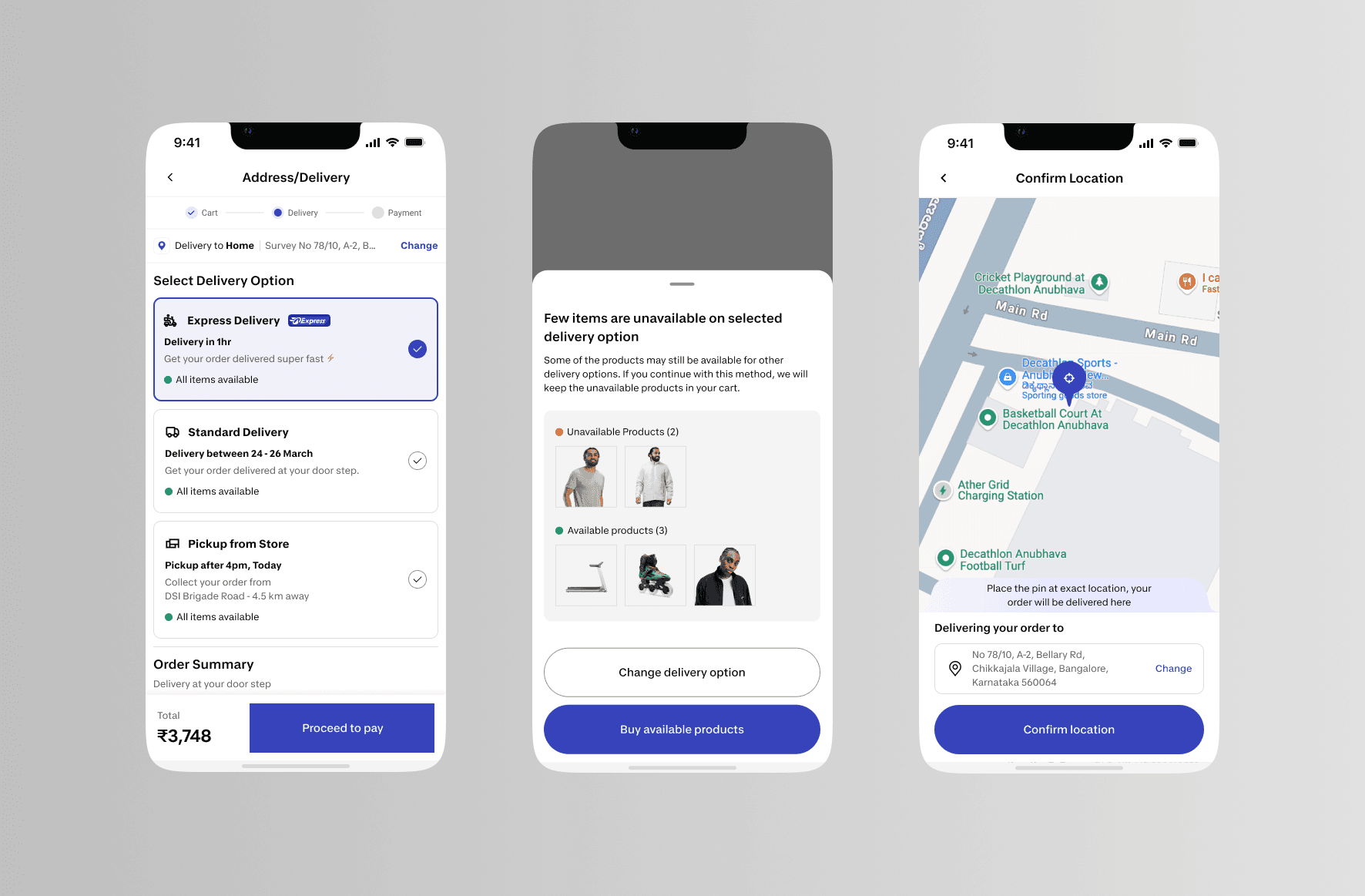
1. Location-First Experience
Made location mandatory for accurate delivery promise
Enabled GPS/manual selection with fallback logic
2. Lead Time Visibility
Displayed delivery ETA at cart level per product
Introduced express eligibility indicators
3. Structured Checkout Flow
Step 1: Cart with delivery preview
Step 2: Address + delivery selection
Step 3: Payment (conditional logic applied)
4. Smart Defaults
Auto-select fastest delivery option (Express > Standard > Pickup)
Reduced decision-making effort
5. Constraint-Based Design
Disabled COD for express deliveries
Prevented invalid delivery selections
Key Design Decisions
Cart (Step 1)
Introduced location-aware delivery estimates
Added inline delivery information per item
Enabled quick location change
Address & Delivery (Step 2)
Mandatory address for serviceability check
Dynamic delivery options based on location and stock
Clear fee visibility and fallback options
Payment (Step 3)
Conditional payment methods based on delivery type
Reduced failure rates by restricting unsupported options
Order Tracking
Immediate delivery promise shown post-order
Status-based tracking (Preparing → In Transit → Delivered)
Live tracking enabled after dispatch
Operational Alignment
Designed around store fulfillment lifecycle:
Paid → Processed → Picked → Packed → Dispatched → Delivered
No cancellation allowed post order confirmation
Returns restricted to store to reduce logistics complexity
Impact
~1.1 hour average delivery time
~10 minutes average packing time
~90%+ SLA adherence
Reduced checkout friction through structured flow
Improved delivery success rate by aligning UX with operational constraints
Key Learnings
Delivery speed must be visible early to build trust
Location is critical for decision-making in quick commerce
Smart defaults significantly reduce cognitive load
UX must reflect real-world operational limitations
Restricting choices can improve overall system success
Future Scope
Partial fulfillment (split cart)
Predictive delivery ETA
Dynamic store selection based on load
Personalized delivery prioritization