Offer Engine
Designing a scalable, intelligent promotion system to power personalized offers and improve conversion across Decathlon’s digital ecosystem
UI/UX
Product Design
Project Overview
The Offer Engine was a foundational platform initiative aimed at transforming how promotions, discounts, and coupons are created, managed, and experienced across Decathlon’s ecosystem.
Previously, offers were managed through fragmented systems with limited flexibility, poor scalability, and inconsistent user experience. This led to missed revenue opportunities, poor discoverability of offers, and frequent customer frustration.
The new Offer Engine was designed as a centralized, scalable, and intelligent system that:
Enables business teams to create complex promotional rules
Automatically surfaces the most relevant offers to users
Integrates seamlessly across web, app, and in-store journeys
It was not just a backend revamp—but a full-stack UX + system redesign impacting both internal tools (BO) and customer-facing experiences (FE).
My Role: I led the UX/UI design across both the customer experience and the internal offer management system. My work involved simplifying complex promotional logic into intuitive interfaces, designing scalable UI patterns for multiple offer types, and ensuring seamless integration of offers across discovery, cart, and checkout journeys. I collaborated closely with product, engineering, and business teams to align user needs with technical capabilities and business goals, while also contributing to the adoption of Decathlon’s new design system.
Problem Statement:
Decathlon’s existing offer and coupon system was fragmented, difficult to scale, and limited in supporting modern promotional strategies. From a user perspective, offers were often hard to discover, understand, or apply—leading to missed savings and reduced trust.
From a business standpoint, the system lacked flexibility to create complex campaigns, personalize offers, or respond quickly to market needs. Additionally, performance issues and system limitations during high-traffic periods negatively impacted conversion and reliability.
The challenge was to design a unified system that could balance business complexity, technical scalability, and user clarity.
Existing app Pain Points:
Customer Experience Issues:
Difficulty discovering relevant offers across the journey
Confusing coupon application with unclear eligibility rules
Hidden conditions (min cart value, product restrictions)
Coupons failing or expiring unexpectedly
Poor visibility of applied discounts at cart and product level
👉 ~10–13% of customer issues were related to coupons/offers
Business & System Issues:
Limited ability to create complex promotional rules
No centralized system → fragmented offer creation
Poor scalability during high-traffic events (sales, campaigns)
High dependency on engineering for launching campaigns
Lack of personalization and targeting capabilities
Information architecture:
The system was redesigned into two key layers:
1. Offer Creation & Management (Back Office)
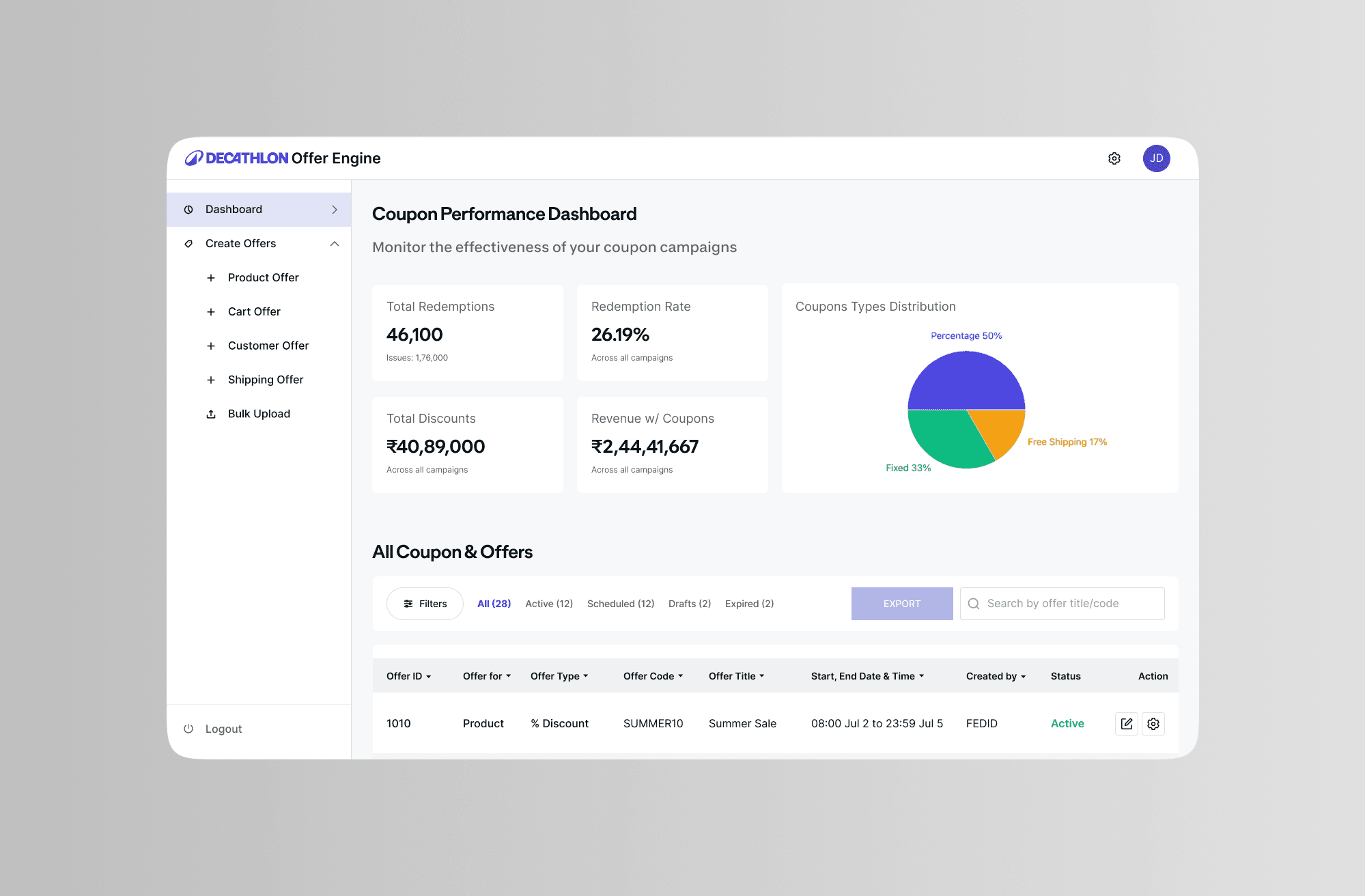
Centralized dashboard to create, manage, and monitor offers
Modular structure for:
Product-level offers
Cart-level offers
Customer-level offers
Bulk upload capabilities (CSV-based)
Role-based access for different stakeholders
2. Offer Discovery & Application (Customer Experience)
Offers surfaced across:
Product Listing Page (PLP)
Product Detail Page (PDP)
Cart & Checkout
Automatic application of eligible offers
Clear visibility of discounts and savings
Wireframes Mockups:
Explored multiple ways to present offers:
Inline vs dedicated offer section
Auto-applied vs manual coupon entry
Tested clarity of offer descriptions (auto-generated vs manual)
Iterated on prioritization logic (“Best offer for you”)
Designed UI for complex scenarios like:
Multi-buy
Bundles
Tiered discounts
Final Direction: A system-driven, auto-applied offer experience with clear visibility and minimal user effort.
Solution:
Key Features:
Centralized Offer Engine: Single platform to create, manage, and track all promotions
Flexible Offer Types:
Percentage & fixed discounts
Bundles & sets
Tiered pricing
BOGO
Coupon codes (visible & invisible)
Smart Eligibility & Personalization:
Based on cart value, product type, user segment
Channel-specific offers (web, app, in-store)
Auto-Apply Best Offer Logic: System automatically selects the most relevant offer
Real-Time Validation Engine: Faster, reliable coupon application even at scale
UI Design Highlights
Customer Experience (FE):
Offer visibility across journey (PLP → PDP → Cart)
Short descriptions on product cards improved clarity & CTR
Offer descriptions auto-generated for consistency
Clear breakdown of discounts at product and cart level
“i” icon for expandable offer details
Back Office (BO):
Dashboard with filters for offer status (Active, Draft, Expired)
Simplified offer creation flow with modular inputs
Auto-generated descriptions based on inputs
CSV upload for bulk campaign creation
Channel selection for omni-channel promotions
Outcomes & Impact:
Improved Offer Discoverability → Higher CTR on product listings
Reduced coupon-related complaints by targeting a 30% reduction goal
Increased successful coupon application rate by ~20%
Enabled system to handle ~500 TPS (transactions per second)
Increased conversion and AOV through better offer visibility and application
Reduced dependency on engineering → faster campaign launches
Built foundation for 35% revenue contribution from offers
Key Learnings:
Designing for promotions is a balance between business flexibility and user clarity
Automation (auto-apply offers) significantly reduces cognitive load
Transparency (clear savings, conditions) builds user trust
Internal tools UX is as critical as customer-facing UX
Scalable systems require thinking beyond screens → into rules, logic, and architecture